
ISO 14001 Consultant Services
Organizations pursuing ISO 14001 usually do not need more documentation for its own sake. They need an Environmental Management System that fits the way the business actually operates, addresses environmental obligations in a structured way, and holds up during certification.
An experienced ISO 14001 consultant helps translate the standard into practical controls, defined responsibilities, measurable objectives, and management processes that can be maintained after the project is over.
For many organizations, ISO 14001 is part of a broader compliance strategy. That is why environmental work often overlaps with ISO Compliance Services or broader advisory support from an ISO Consultant.
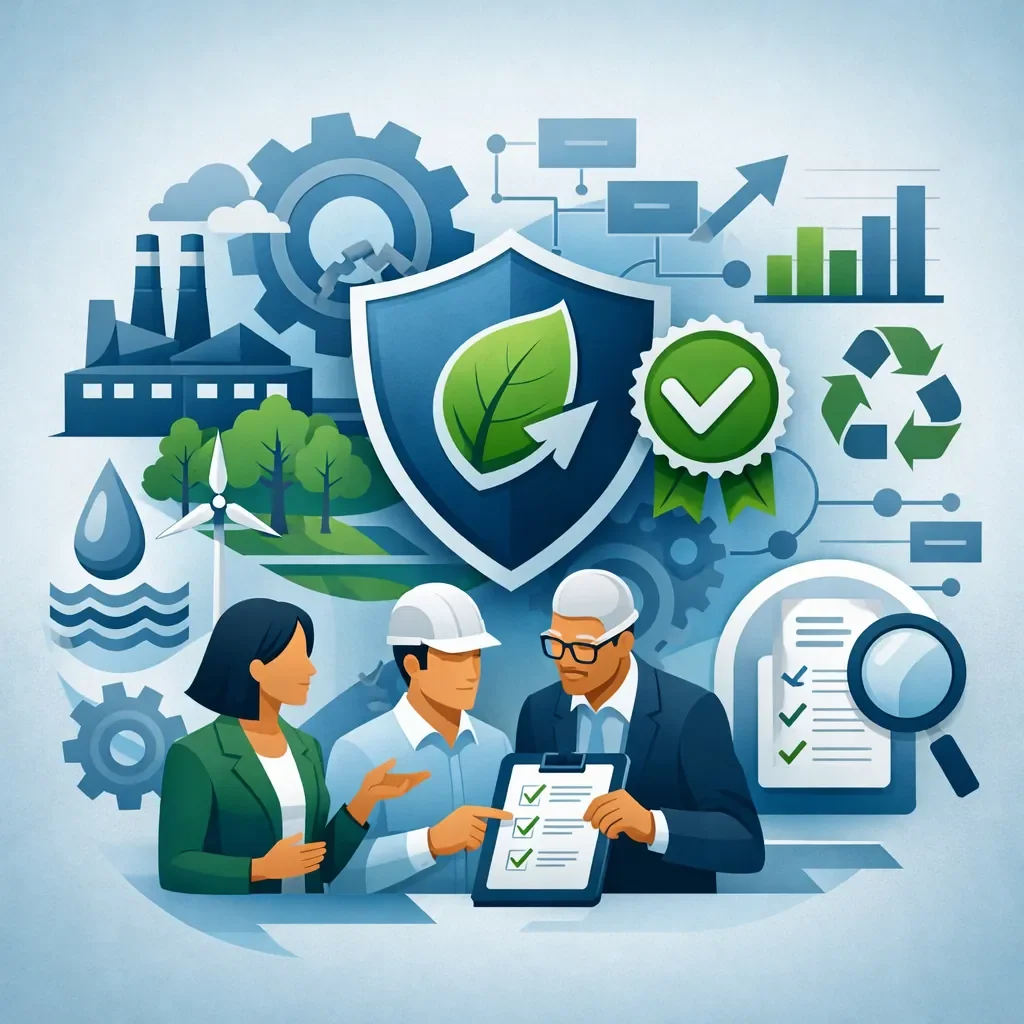
What an ISO 14001 Consultant Actually Does
A capable ISO 14001 consultant does more than explain clause language. The real job is to help the organization design and implement an EMS that aligns with its risks, activities, obligations, and operational structure.
Typical support includes:
Evaluating current environmental practices against ISO 14001 requirements
Identifying environmental aspects, impacts, risks, and compliance obligations
Developing EMS documents, controls, and operational procedures
Establishing environmental objectives, metrics, and monitoring methods
Defining roles, accountability, and management review inputs
Training leadership and operational teams on system responsibilities
Supporting internal audits, corrective actions, and certification readiness
Helping the organization build a maintainable system rather than a temporary certification package
Organizations that already operate a formal ISO 9001 Quality Management System often move through ISO 14001 implementation more efficiently because core management system structures are already familiar.
When Organizations Typically Need ISO 14001 Consulting
Some organizations bring in outside support at the beginning of implementation. Others reach out after realizing their current system is incomplete, overly generic, or not ready for audit.
Common triggers include:
Preparing for first-time ISO 14001 certification
Expanding customer or supply chain requirements
Needing more structure around environmental compliance obligations
Building consistency across sites or operational functions
Integrating environmental controls into an existing management system
Recovering from a weak prior implementation effort
Preparing for surveillance, recertification, or a transfer audit
Where quality, environmental, and safety systems need to work together, organizations often benefit from an Integrated ISO Management Consultant rather than treating each standard as a separate project.
What to Look for in an ISO 14001 Consultant
Not all consultants approach environmental management the same way. Some are heavily documentation-focused. Others understand how to build a system that leadership can actually use to manage risk, performance, and accountability.
Important capabilities include:
Experience implementing ISO 14001 across different operating environments
Strong understanding of EMS structure, audit expectations, and certification process
Ability to evaluate environmental aspects in practical operational terms
Familiarity with compliance-driven controls and documented accountability
Skill integrating ISO 14001 into broader management system architecture
Ability to keep the system usable after certification
For organizations combining standards, EMS work is often folded into IMS Consulting Services so shared controls, audits, and review activities are designed once instead of duplicated.
Our ISO 14001 Consulting Approach
ISO 14001 works best when it is implemented as an operating system, not a paperwork exercise. The consulting approach should reflect the size, complexity, and environmental profile of the organization.
1. Gap Assessment and Implementation Planning
The work usually starts by identifying what already exists, what is missing, and what needs to be formalized to support certification.
This phase typically includes:
Review of current environmental controls and responsibilities
Evaluation of existing documents and operational practices
Identification of EMS gaps against ISO 14001 requirements
Initial review of environmental aspects and obligations
Project scoping, sequencing, and implementation priorities
For organizations that need a formal starting point, this is often structured as an ISO Gap Assessment.
2. EMS Design and Documentation
Once the gaps are clear, the next step is building the actual system. That includes defining the documented framework, process controls, and management mechanisms needed for the EMS to function.
This often includes:
Environmental policy development
Scope definition for the EMS
Aspect and impact evaluation methods
Compliance obligation tracking
Environmental objectives and planning methods
Operational control procedures
Monitoring and measurement processes
Corrective action and continual improvement structure
The goal is not to produce maximum documentation. The goal is to establish enough structure to control environmental performance and demonstrate conformity.
3. Implementation and Operational Adoption
A documented system is not enough. Teams need to understand how the EMS applies to their work and how management will use the system.
Implementation support often includes:
Role-based EMS awareness training
Leadership alignment on responsibilities and review expectations
Rollout of operational controls and required records
Support for environmental objective tracking
Guidance on internal communication and system use
4. Internal Audit and Certification Readiness
Before certification, the EMS needs to be tested. That means verifying that the system is implemented, followed, and capable of supporting an external audit.
This phase often includes:
Internal EMS audit support
Nonconformity and corrective action follow-up
Management review facilitation
Readiness review against certification expectations
Audit coordination and final preparation
Organizations that need help validating the system before the registrar arrives often use ISO Internal Audit Services and ISO Audit Preparation Services as part of the final push.
What Effective ISO 14001 Consulting Should Deliver
By the end of a well-run project, the organization should have more than a certificate-ready binder. It should have a functioning Environmental Management System with clear ownership and practical controls.
Expected outcomes typically include:
Defined EMS scope and system structure
Environmental policy and aligned objectives
Method for evaluating aspects, impacts, and obligations
Operational controls tied to actual environmental risk
Monitoring and measurement practices
Internal audit and management review mechanisms
Corrective action structure for continual improvement
A system that can be maintained after certification
Benefits of Working With an ISO 14001 Consultant
The value of ISO 14001 consulting is not limited to passing the audit. A well-designed EMS helps the organization manage environmental issues in a more deliberate and consistent way.
Key benefits often include:
Clearer control over environmental responsibilities
Better visibility into environmental risks and obligations
More structured monitoring and performance review
Improved consistency across departments or locations
Stronger audit readiness and reduced certification friction
Better foundation for integrated management system growth
Organizations looking beyond environmental management alone may also evaluate an ISO 50001 Consultant when energy performance is a significant part of the compliance and operational picture.
ISO 14001 Consulting for Integrated Systems
Many organizations do not want a standalone EMS that operates in isolation. They want environmental management to align with quality, safety, risk, and business decision-making.
That is often the right approach. ISO 14001 shares common structural elements with other ISO management system standards, which makes integration practical when it is planned correctly.
Integrated work can help reduce:
Duplicate procedures
Repetitive audits
Fragmented objectives
Conflicting responsibilities
Unnecessary administrative burden
This is especially useful for organizations already managing multiple frameworks under a single governance structure.
How Long ISO 14001 Implementation Usually Takes
Implementation time depends on operational complexity, number of sites, existing documentation maturity, and how much management system structure is already in place.
A typical project often moves through these phases:
Initial assessment and planning
EMS design and documentation
Implementation and training
Internal audit and corrective action
Certification readiness and external audit support
Some organizations move quickly because they already have management system discipline. Others need more time because the EMS is being built from the ground up. The right timeline is the one that produces a system the organization can actually maintain.
Ongoing Support After Certification
Certification is not the end of the work. The EMS has to remain active, monitored, and reviewable between audits.
Post-certification support may include:
Surveillance audit preparation
Internal audit execution
Objective and KPI review
Corrective action support
EMS updates after organizational change
Continued advisory support for system maintenance
For organizations treating ISO 14001 as part of a longer-term management system strategy, ongoing support is often more valuable than a one-time documentation project.
If You’re Also Evaluating…
Contact us.
info@wintersmithadvisory.com
(801) 477-6329