
ISO 27001 Certification Consulting for Information Security Leaders
What Is ISO 27001 Certification Consulting?
ISO 27001 certification consulting supports organizations in designing, implementing, and preparing Information Security Management Systems (ISMS) for certification.
This is not a documentation exercise. ISO 27001 is a risk-based governance system that requires structured control implementation, measurable performance, and ongoing oversight.
Certification validates the system. The system must function under real operational conditions.
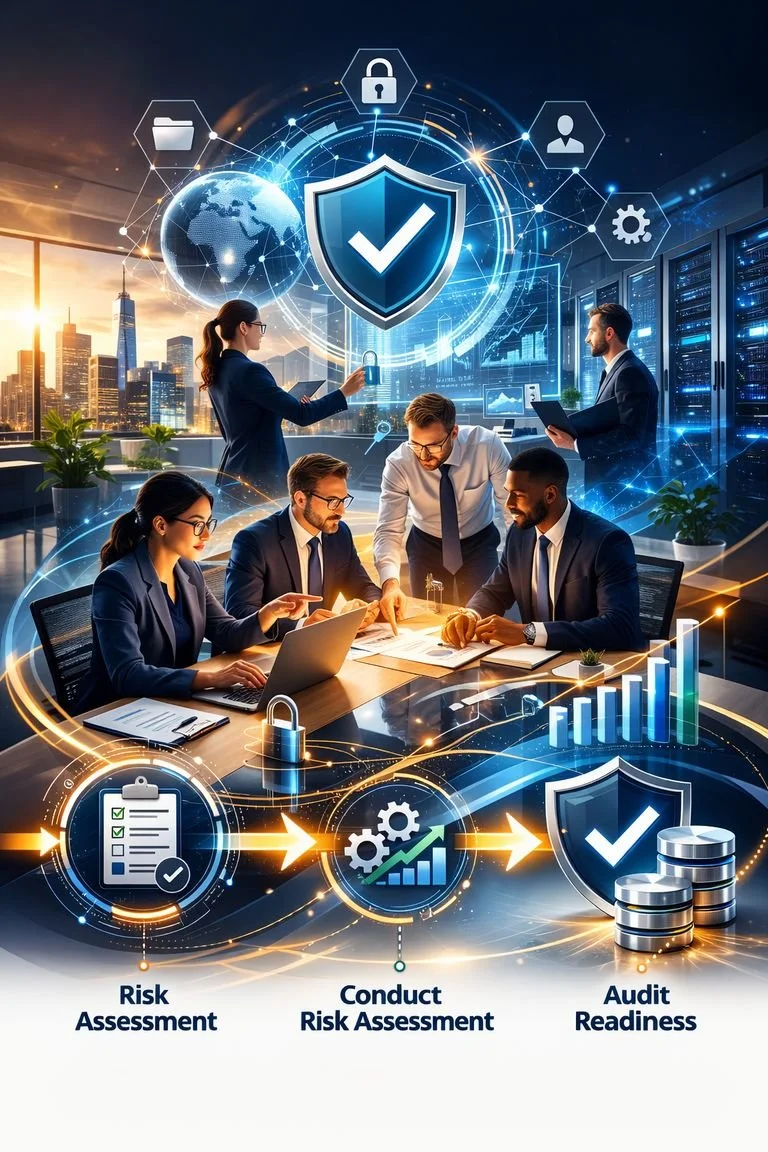
What ISO 27001 Certification Consulting Actually Covers
ISO 27001 consulting focuses on building a controlled, risk-driven ISMS.
Core elements include:
Identification and classification of information assets
Risk assessment and treatment planning
Control selection and implementation
Documented governance processes
Monitoring and measurement of control effectiveness
Continual improvement of the ISMS
Organizations formalizing their approach often engage ISO 27001 Certification Consultants to ensure structured implementation and audit readiness.
Who Needs ISO 27001 Certification Consulting
ISO 27001 consulting is commonly required for:
SaaS and technology companies
Cloud service providers
Managed service providers
Fintech organizations
Healthcare technology firms
Government contractors
Organizations handling sensitive or regulated data
Enterprise customers increasingly require ISO 27001 certification as a baseline trust indicator.
Organizations operating in regulated or defense environments often align efforts with CMMC 2.0 Compliance Consulting.
Cloud-focused organizations may also extend controls through ISO 27017 & 27018.
Step 1: Define the Scope of the ISMS
The organization must clearly define system boundaries.
This includes:
Physical and logical environments
Information assets and systems
Business units and functions
Interfaces with third parties
Scope determines audit coverage and risk exposure. Poor scoping creates either unnecessary audit risk or limited certification value.
Step 2: Conduct a Risk Assessment
ISO 27001 is fundamentally risk-driven.
This includes:
Identifying information assets
Identifying threats and vulnerabilities
Evaluating likelihood and impact
Defining risk treatment plans
Selecting appropriate controls
Organizations seeking alignment with broader governance structures often integrate with ISO Risk Management Consulting to maintain consistency across enterprise risk domains.
The risk assessment drives the Statement of Applicability (SoA) and defines audit defensibility.
Step 3: Develop the ISMS Framework
A structured ISMS requires cohesive documentation and governance.
Core components include:
Information security policy
Risk management methodology
Statement of Applicability (SoA)
Access control procedures
Incident response plan
Supplier security requirements
Business continuity integration
Internal audit program
Organizations typically engage ISO 27001 Consultant Services to ensure alignment between system design and operational execution.
Step 4: Implement and Operationalize Controls
Auditors evaluate whether controls function in practice.
Implementation includes:
Access control enforcement
Logging and monitoring activities
Incident response testing
Vendor and supplier risk assessments
Security awareness training
Execution of internal audits
Weak operationalization is one of the most common causes of audit findings.
Step 5: Internal Audit and Management Review
Before certification, the organization must demonstrate system control.
This includes:
Full internal audit coverage of the ISMS
Management review of system performance
Corrective action on identified issues
This phase often aligns with ISO Internal Audit Services and ISO Audit Preparation Services.
Leadership involvement is required and evaluated during certification.
Step 6: Certification Audit
The certification body evaluates system design and effectiveness.
This includes:
Stage 1 documentation review
Stage 2 effectiveness audit
Risk assessment validation
Control sampling and testing
Evidence review
Certification is granted once nonconformities are addressed.
Common Challenges in ISO 27001 Certification
Organizations frequently struggle with:
Overcomplicated or inconsistent risk assessments
Poorly structured Statements of Applicability
Selecting too many or too few controls
Weak supplier and third-party security oversight
Treating ISO 27001 as a documentation exercise
Failing to integrate business continuity planning
ISO 27001 requires governance discipline and operational consistency.
Strategic Value of ISO 27001 Certification
When implemented correctly, ISO 27001 supports:
Enterprise sales enablement
Regulatory and contractual credibility
Eligibility for government and enterprise contracts
Improved cyber risk management
Stronger customer trust and assurance
Better alignment with insurance and security expectations
Certification is the milestone. Controlled information security is the outcome.
Why Wintersmith Advisory
We support organizations by building ISMS frameworks that operate under real conditions.
That includes:
Structured gap assessments and implementation roadmaps
Risk assessment model design and integration
Control selection and SoA development
ISMS architecture aligned to business operations
Internal audit execution
Management review facilitation
Certification readiness preparation
Our approach aligns with ISO Compliance Consulting — structured, practical, and audit-ready.
We do not certify. We build systems that pass certification and sustain performance.
If You’re Also Evaluating…
The objective is not certification alone. It is a defensible, risk-driven information security system that supports long-term growth.
Contact us.
info@wintersmithadvisory.com
(801) 477-6329