
ISO 22301 Certification
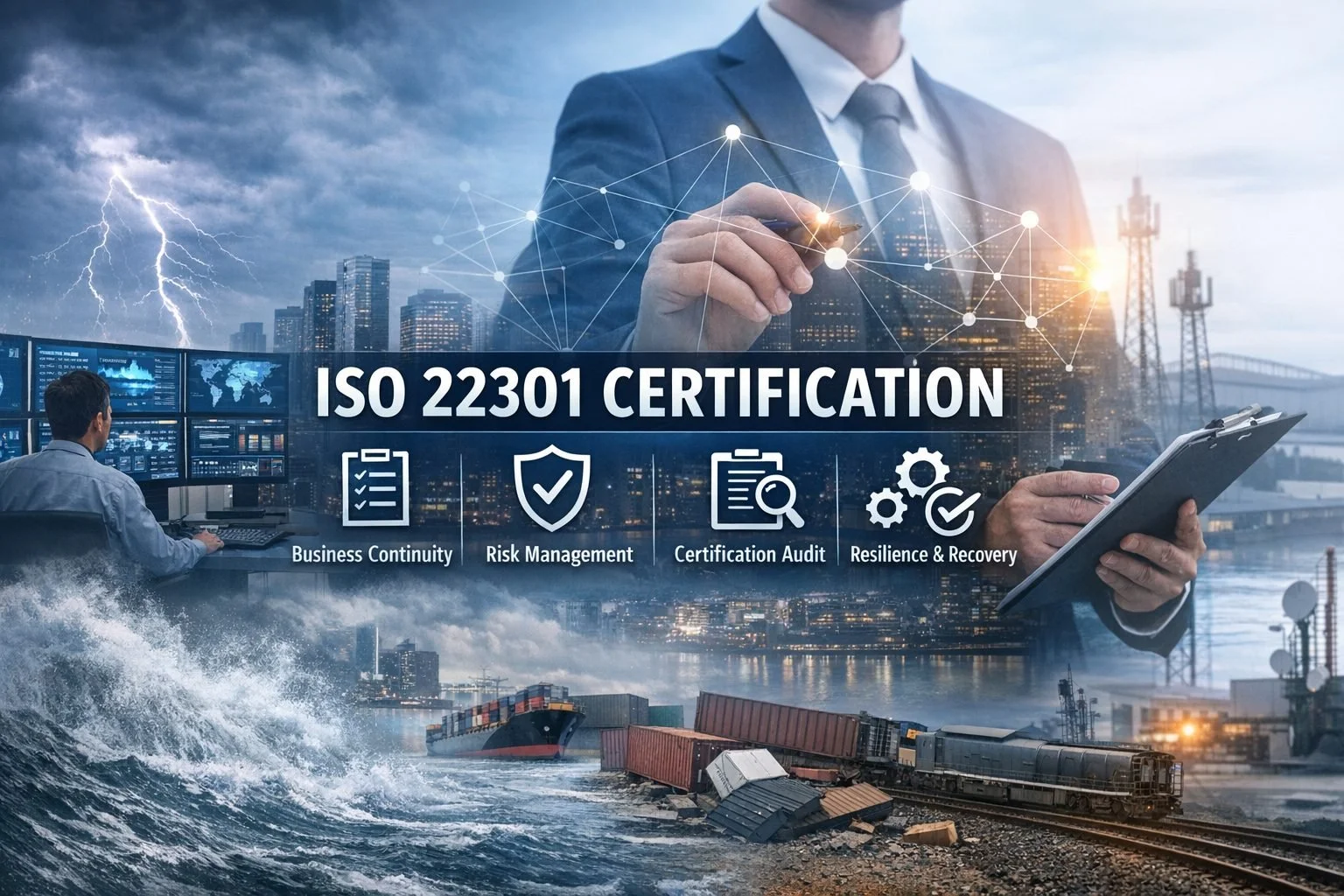
ISO 22301 Certification demonstrates that your organization has implemented a structured, internationally recognized Business Continuity Management System (BCMS) designed to withstand disruptions and recover effectively.
Whether your risks involve cyberattacks, supply chain failures, natural disasters, or operational outages, ISO 22301 certification provides formal validation that your organization is prepared.
For companies operating in regulated sectors, enterprise supply chains, or government contracting environments, resilience is no longer optional. Certification is increasingly contractual.
What Is ISO 22301 Certification?
ISO 22301 certification is third-party confirmation that your organization conforms to the international standard for business continuity management.
Certification verifies that you have:
Identified critical business processes
Conducted a Business Impact Analysis (BIA)
Assessed and treated disruption risks
Developed documented continuity and recovery plans
Established crisis management structures
Tested and exercised response procedures
Implemented continual improvement processes
Certification is granted by an accredited certification body following successful Stage 1 and Stage 2 audits.
For organizations new to formal ISO programs, reviewing the broader framework of ISO Certification Services helps clarify how surveillance cycles and audit structures work across standards.
Why ISO 22301 Certification Matters
ISO 22301 certification is not about binders on shelves. It is about operational resilience under pressure.
Risk Reduction
Structured identification of threats and vulnerabilities
Defined recovery objectives (RTO/RPO)
Clear escalation and response protocols
Executive accountability during crisis
Organizations already investing in enterprise-level risk oversight often align ISO 22301 with ISO Risk Management Consulting to ensure continuity planning supports broader risk governance.
Contractual & Market Advantage
Meets procurement and enterprise vendor requirements
Demonstrates operational reliability
Builds stakeholder confidence
For companies serving federal or defense markets, ISO 22301 may complement CMMC 2.0 Compliance Consulting efforts when resilience expectations extend beyond cybersecurity controls.
Regulatory & Governance Alignment
Strengthens board-level oversight
Integrates with enterprise risk frameworks
Formalizes leadership accountability
Resilience becomes part of governance, not an IT function.
ISO 22301 Certification Requirements Overview
To achieve certification, your BCMS must address the following core clauses:
Context of the Organization
External and internal issues
Interested parties and requirements
Defined BCMS scope
Leadership
Business continuity policy
Defined roles and responsibilities
Top management accountability
Planning
Risk assessment methodology
Business Impact Analysis (BIA)
Business continuity objectives
Support
Competence and awareness
Communication planning
Documented information controls
Organizations formalizing documentation structures often align continuity controls with broader ISO Management System Consulting approaches to maintain consistency across standards.
Operation
Business continuity strategies
Incident response structure
Continuity and recovery plans
Testing and exercises
Performance Evaluation
Internal audits
Management review
Monitoring and measurement
Effective internal audit capability is often strengthened through ISO Internal Audit Services before certification audits begin.
Improvement
Corrective action process
Continual improvement framework
ISO 22301 is governance-driven and cyclical. Certification requires proof of implementation — not just intent.
ISO 22301 Certification Process
A disciplined certification path typically includes:
1. Gap Assessment
Evaluate your current resilience posture against ISO 22301 requirements. Many organizations begin with an ISO Gap Assessment to quantify implementation effort and timeline risk.
2. BCMS Design & Implementation
Develop policies, procedures, BIA documentation, risk registers, and crisis management plans.
3. Testing & Exercising
Conduct tabletop simulations and scenario-based exercises to validate response capability.
4. Internal Audit
Verify conformance and leadership readiness before external audit.
5. Certification Audit
Stage 1: Documentation review
Stage 2: Implementation verification
6. Ongoing Surveillance
Annual surveillance audits maintain certification validity within a three-year cycle.
How Long Does ISO 22301 Certification Take?
Timelines vary based on complexity and organizational maturity:
3–6 months for smaller organizations
6–12 months for mid-sized organizations
12+ months for multi-site or high-risk enterprises
Organizations integrating continuity with existing ISO programs often move faster due to Annex SL alignment.
What Are the Costs of ISO 22301 Certification?
Costs generally include:
Consulting & Implementation Support
Gap assessment
BCMS framework development
Exercise facilitation
Internal audit preparation
Certification Body Fees
Stage 1 and Stage 2 audits
Annual surveillance audits
Three-year certification cycle
Total investment depends on scope, risk exposure, and organizational size.
Who Needs ISO 22301 Certification?
ISO 22301 certification is particularly valuable for:
SaaS and technology companies
Financial services firms
Healthcare organizations
Manufacturers with critical supply chains
Defense contractors
Infrastructure operators
Enterprise vendors serving regulated clients
For organizations managing sensitive information environments, ISO 22301 frequently complements ISO 27001 Certification Consulting within an integrated resilience strategy.
Common Misconceptions About ISO 22301 Certification
“We already have disaster recovery plans.”
ISO 22301 requires structured governance, formalized testing, leadership oversight, and continual improvement — not just recovery documentation.
“Cybersecurity certification is enough.”
Information security addresses data protection. Operational continuity addresses enterprise survival. Organizations pursuing ISO 27001 Certification Services often expand into ISO 22301 to cover broader disruption risk.
“Business continuity is just IT.”
ISO 22301 is organization-wide and leadership-driven. It spans operations, supply chain, facilities, HR, and executive governance.
Integrating ISO 22301 With Other Standards
ISO 22301 aligns seamlessly with:
ISO 27001 (Information Security)
ISO 9001 (Quality Management)
ISO 14001 (Environmental Management)
ISO 45001 (Occupational Health & Safety)
Organizations pursuing multiple frameworks frequently centralize governance through Integrated ISO Management Consultant support to avoid siloed implementation.
Strategic Benefits of ISO 22301 Certification
Improved executive decision-making under crisis
Faster recovery from disruption
Reduced operational downtime
Increased customer trust
Stronger insurance positioning
Competitive differentiation
In volatile markets, resilience becomes a strategic advantage — not simply a compliance artifact.
Preparing for ISO 22301 Certification
To begin:
Identify an executive sponsor
Define BCMS scope
Conduct preliminary risk review
Inventory critical processes
Map dependencies and suppliers
A structured readiness review reduces certification risk and compresses timelines.
ISO 22301 Certification Support
Successful ISO 22301 certification requires technical depth and governance alignment. Business continuity planning must be embedded into leadership structures — not delegated as a compliance task.
Organizations benefit most when implementation is disciplined, scoped correctly, and audit-aligned from the outset.
Next Strategic Considerations
Organizations pursuing ISO 22301 certification often evaluate:
Resilience should support enterprise strategy. Certification should validate maturity — not create administrative burden.
Contact us.
info@wintersmithadvisory.com
(801) 477-6329